The chart, streamlined

Everything that keeps a patient safe, never more than a glance away.

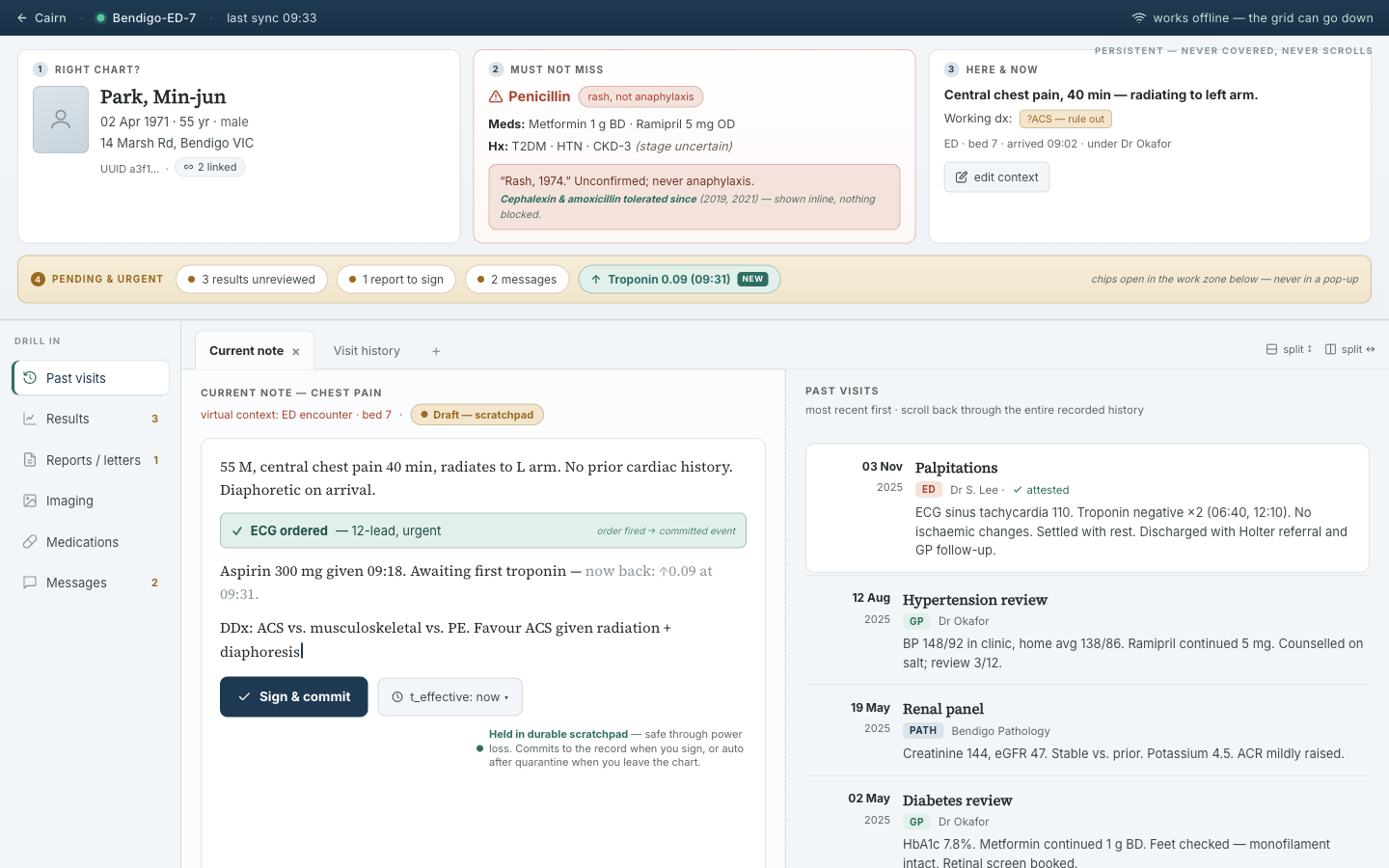
One screen, two zones. A persistent zone that can never be scrolled away or covered, and a work zone that splits side by side. No blocking pop-ups — because a dialog you have to dismiss is something paper never made you do.

The Cairn chart for Min-jun Park: a persistent identity and safety zone across the top, and below it a split work zone with a live progress note beside an endlessly scrollable past-visits history. Full screen Open the interactive chart

Click to open it full screen. Clinical content is illustrative. Inside: try the rail and the troponin chip, and scroll the past-visits history right back to the start of the record.

Open the full-screen chart →

Why it is shaped this way

Four decisions doing the heavy lifting

None of this is decoration. Each choice traces back to a founding principle — most of all, that no clinical workflow may lose to its paper equivalent.

The split

A zone that never goes away

Identity, allergies, current meds, the reason they’re in front of you, and what’s still outstanding stay pinned at the top — they can’t be scrolled past or buried under a window. The paper chart’s front sheet was always face-up; so is this.

Paper-parity · acknowledged uncertainty

No blocking modals

Detail opens beside, not over

Expanding the penicillin note, reviewing the new troponin, opening a past visit — all of it lands next to what you’re doing, never on top of it, each pane scrolling on its own so any two views sit side by side. A dialog you must dismiss is not a safety mechanism; it’s an interruption paper never imposed.

Paper-parity · confirmation dialogs are explicitly rejected

The whole story

An endless history, one scroll away

Past visits open on the most recent and keep going — scroll back through years of the record without paging, dialogs, or date-pickers, the way you’d thumb back through a paper folder. The relevant visit is usually the recent one; everything before it is still right there when it isn’t.

Paper-parity · respects the clinician’s time

Committed on your terms

A durable scratchpad, not an instant commit

Working notes are written to a non-volatile scratchpad — safe through a power cut the instant they’re typed — but nothing enters the permanent record until you sign off, or, if you move to other patients or log out, it auto-commits after a configurable quarantine. A differential is revised constantly; the clinician owns the moment it becomes part of the record.

Append-only · availability over consistency · acknowledged uncertainty

Built from the chart-two-zone and active-write sketches. The persistent / work split, the no-modal rule, and the scratchpad-then-commit model are the load-bearing decisions.

This is design work, in the open.

The interface is reasoned the same way as the architecture — against real failure modes from the front line. A well-described clinical workflow is as valuable a contribution as code.

Get involved